A new project of collecting informations and instrument making.


Um novo projeto de pesquisa e levantamento de informações sobre o Baryton da Gamba (Gambarítono). Em português, inicialmente.
Várias postagens ainda estão em fase de construção.

A new project of collecting informations and instrument making. In Portuguese.
The posts are still under construction.


Mostrando postagens com marcador Henner Harders (luthier). Mostrar todas as postagens

terça-feira, 26 de julho de 2011

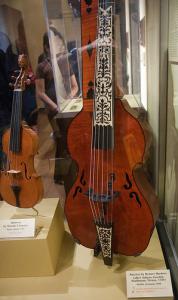
Baryton de 2008 do Natural Museum of American History, do Instituto Smithsonian


Feito em Putlitz, em 2008, baseado em J. J. Stadlmann de ca. 1750. Encontra-se também no National Museum of Natural History, do Instituto Smithsonian, Washington, D.C., USA.
Parece ser o do luthier Henner Harders (ver outra postagem).


No site do Smithsonian, encontra-se a referência ao Esterhazy Machine, em que um de seus diretores toca o baryton, que pode ser o mesmo acima.

The Esterházy Machine

The Esterházy Machine—Kenneth Slowik, baryton and fortepiano; Steven Dann, viola and violin; Myron Lutzke, violoncello—takes its name from a casual remark made by Dutch cellist Anner Bylsma, who referred to the baryton, favorite instrument of Joseph Haydn’s employer Prince Nikolaus Esterházy “the Magnificent,” as “that Esterházy machine.” With six bowed strings and nine sympathetic strings (which may also be plucked by the left thumb), the baryton is indeed an unwieldy-looking instrument that might have fallen into eternal oblivion at the end of the 1800s but for the fact that Haydn wrote nearly 200 pieces for it. In its baryton—viola—cello formation, the Esterházy Machine addresses this sonically unique repertoire, while its violin—cello—fortepiano configuration allows it to play the rich keyboard trio repertoire of Haydn, Mozart, and their contemporaries.

http://smithsonianchambermusic.org/about/ensembles/esterhazy-machine


E também a capa do programa da temporada de 2009-2010 com a foto do baryton:

http://smithsonianchambermusic.org/concerts/past/2009%E2%80%932010-season

Henner Harders, luthier atual, baryton baseado em J. J. Stadlmann

Henner Harders, luthier atual trabalhando em Mansfeld e Putlitz, na Alemanha, faz barytons entre vários outros instrumentos. Aqui estão dois deles, o primeiro baseado no baryton do príncipe Esterhazy, feito por J. J. Stadlmann em 1750.

Esses são os músicos do Trio Baryton Polonês ('The Polish Baryton Trio'):
Kazimierz Gruszczynski - Baryton
Violette Pluzek - Viola
Maria Sarap - Cello


Outro baryton:


O site de Henner Harders (e sua parceira Susanne Küster que esculpe as figuras no cravelhame para ele e muitos outros luthiers) é o www.violworks.com.


* * * * * *
Texto do site:

Baryton


after J. J. Stadlmann, Vienna 1750, Esterhazy’s Baryton

As the model for my instrument I use the baryton made by Johann Joseph Stadlmann in 1750 for Prince Esterhazy. The highly decorated original is on display in Budapest. The back, for instance, is made from three separate pieces joined in a wavy line.

7 playing strings, 10 metal strings.

Body length 60.5 cm, string length ca. 63,5 cm.

'It is my great pleasure to play a baryton made by Henner Harders. This instrument speaks very light and
brisk, has a noble sound and a good characteristic resonance. Perfection and accuracy of carvings
- 'Real viols maker’s masterpiece' - this is not only my opinion, but also that of many musicians in Poland'.

Kazimierz Gruszczyñski - founder and leader of The Polish Baryton Trio