A new project of collecting informations and instrument making.


Um novo projeto de pesquisa e levantamento de informações sobre o Baryton da Gamba (Gambarítono). Em português, inicialmente.
Várias postagens ainda estão em fase de construção.

A new project of collecting informations and instrument making. In Portuguese.
The posts are still under construction.


terça-feira, 26 de julho de 2011

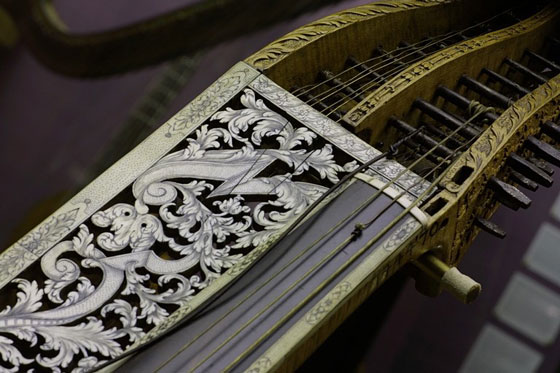
Baryton de luthier anônimo do início séc 18 (Museu Instrumentos Musicais, MIM, de Bruxelas, Bélgica)


No Museu dos Instrumentos Musicais de Bruxelas, Bélgica, encontra-se este exemplar feito por luthier anônimo, no começo do século 18, na Áustria ou sul da Alemanha.


* * * * * * * *

Texto do site:

baryton
cordophone

Alors qu'il était déjà utilisé au 17e siècle, le baryton, -instrument à cordes frottées-, ne sera véritablement apprécié que beaucoup plus tard. C'est en effet dans la deuxième moitié du 18e siècle et sous l'influence de Joseph Haydn, que l'instrument jouit d'une véritable reconnaissance. Pendant de nombreuses années Haydn occupe le poste de maître de chapelle de la famille Esterházy. Son protecteur, le prince Nicolas, joue lui-même du baryton ; raison pour laquelle, peut-être, Haydn compose environ 175 oeuvres pour cet instrument. Les trios avec alto et violoncelle sont parmi les pièces les plus connues du répertoire pour baryton.

La présence de frettes, les épaules tombantes et la tête sculptée du manche lui donnent l'aspect d'une viole de gambe. Mais à la différence de celle-ci, le baryton possède à l'arrière du manche une série de cordes sympathiques en métal dont le nombre peut varier considérablement d'un instrument à l'autre. Ces cordes métalliques ont une double fonction : elles sont pincées avec le pouce de la main gauche et, par leur résonance, elles enrichissent le son des cordes de boyaux frottées par l'archet.

Notre M0231 a été construit par un facteur anonyme au début du 18e siècle, au Sud de l'Allemagne ou en Autriche.

Cet instrument est un des 50 instruments insolites du MIM.

http://www.mim.be/

Johann Andreas Kämbl (1699-1781) (luthier), München 1745 (Museu Nacional da Bavária)

Baryton de Johann Andreas Kämbl (1699-1781), Munique, 1745.
No Museu Nacional da Bavária, Munique, Alemanha (número de inventário do museu: 30).
Abeto e bordo.
Altura de 132 cm.

http://www.bayerisches-nationalmuseum.de/Win/c/c02/c023sc09.htm

Jacques Sainprae (luthier), Berlim (origem franco-huguenote) ca. 1720 (Museu Victoria e Albert inglês)


Jacques Sainprae de Berlim (origem franco-huguenote) ca. 1720, atualmente no Museu Victoria e Albert inglês (www. vam.ac.uk)

[Orfeu e sua lira esculpidos (de longe parece um belo trabalho) sobre o cravelhame; cravelhame duplo; cravelhas parecem apenas pinos metálicos; escalas e estandarte decorados (a escala dedilhada apenas na metade inferior), 3 cavaletes: 1 pequeno para as cordas friccionadas (não tem uma perna longa como na maioria dos modelos!) e outros 2 (!!!) sobre o tampo; chamas duplas e opostas (bem inclinadas); sem a dobra/bico junto à largura inferior; curvas mais simples no formato do corpo; reentrância estreita na culatra.]

Outros detalhes do site:

Baryton
Jacques Sainprae
Berlin, Germany
about 1720
Carved sycamore, planed pine and sycamore, engraved ivory and tortoiseshell veneer
Length 133 cm (total)
Length 70 cm (belly)
Depth 14 cm
Width 19 cm (Upper bout)
Width 23.5 cm (Lower bout)
Museum no. 1444-1870

This baryton was made by Jacques Sainprae of Berlin in about 1720. Sainprae was most likely of French Huguenot origin, but this is the only surviving instrument to bear his signature, and nothing else is known about him. However, this example is made to the highest standard, and the exquisitely carved finial represents Orpheus playing a lyre.
The baryton was a central European instrument that enjoyed a vogue between about 1640 and 1800. The most famous baryton composer was Josef Haydn (1732-1809) who wrote a large number of pieces for his patron, Prince Nikolaus Esterházy (1714-1790), a Hungarian nobleman and an enthusiastic amateur player.

Daniel Achatius Stadlmann (luthier), Viena 1715 (Museu de Leipzig)


Baryton feito por Daniel Achatius Stadlmann em Viena, 1715, que se encontra no Museu de Instrumentos Musicais da Universidade de Leipzig, Alemanha. Pertenceu a Esterhazy.


Daniel Achatius Stadlmann, Wien 1715
Museum für Musikinstrumente der Universität Leipzig
Inv.-Nr. 855


[apresenta 6+14 cordas e dois cordais (estandartes individuais) p/ cordas simpáticas]

Joachim Tielke 1686. Museu Victoria & Albert, de Londres

O baryton de 1686 do luthier Joachim Tielke
. Museu Victoria & Albert, de Londres (Museum no. 115 to B, D to Q-1865) tem 6 + 21 cordas

[pinos metálicos em vez de cravelhas nas cordas simpáticas; 3 leões; braço vazado; muitos parafusos c/ porcas]


[AGUARDE]

Hans Kögl (luthier), Viena 1679 [Museu de Berlim] e Joseph Neuner

O maior é de Hans Kögl, luthier em Viena, de 1679.
O menor é de Joseph Neuner, de 17-- (?).
Estão no Museu de Berlim, um com 6 + 9 e o menor com 6 + 12 cordas.
Atualmente no Institute für Musikforschung de Berlim, foi feito por Hans Kögl em Viena em 1679. Desenho frontal da metade inferior do corpo à venda no museu.


Altura total, 122,6 cm.
Altura corpo, 60,8 cm.
Comprimento das cordas friccionadas, 65,7 cm.
Comprimento máximo da corda dedilhada, 91 cm.
Tem 6 cordas friccionadas e 9 cordas simpáticas/dedilhadas.


* * * * * * *

Texto a seguir extraído do blog de Rod Byatt (Viola da Gamba Weblog):


Kogl 1679
There is no picture of this extant baryton from the 17th century, but plans for making it are available.
Currently located in the Institut fur Muiskforschung, Berlin, it was made in Vienna by Hans Kogl in 1679.
Gartrell in her book gives the following dimensions: total length, 122.6cm, body length, 60.8; length of bowed strings, 65.7, maximum length of plucked string, 91. It is a plain instrument with 6 bowed strings and 9 plucked strings. There is apparently a reference to it in “The Baryton”, Consort 23 (1966):121 by Janos Liebner.
This instrument pre-dates the first publication of music for the bartyon around 1700 by Krause, but commentators in the late 17th century link the instrument to music for solemn or mournful occasions. Thus it was used as an obbligato instrument for four of the arias in Emperor Leopold I’s arias in his Miserere per la Settimana Santa (c.1660).
While the published dances for amateurs and professionals of Krause stand 20 years after the Kogl instrument was made, 20 years before saw three baryton pieces composed by John Jenkins and ending up in the Kassel collection. For me, then, the Kogl instrument makes a nice bridge between the English viol repertoire and the burgeoning baryton on the Continent in northern Germany. To quote Gartrell:
By the opening of the eighteenth century, the baryton had made its way from England to northern Germany. Its repertory consisted largely of music arranged from the lute and lyra viol music of the day. Its fame, progress, and reputation sat within the four closely related courts of England, Wurttemberg, Brandenburg and Kassel, and a small group fo mobile composer-performers were responsible for its dissemination and growing reputation. This, then is the apotheosis of the baroque baryton, an instrument defined by its role as a solo, self-accompanying instrument and at the peak of its development.
In Gartrell’s inventory of extant baryton manuscripts, music from c.1679 would have to include the Gottfried Finger 7 Suites for gamba and accompanying baryton; the four arias with obbligato baryton by Emperor Leopold I and Antonio Draghi’s aria, I miei sensi, with baryton obbligato from La vita nella morte.
References
Gartrell, Carol A. A History of the Baryton and its Music.
Musikinstrumenten-Museum des Staatlichen Instituts fur Musikforschung, Berlin. Verziechnis der technischen Zeichnugnen. Catalogue number Z 86, 10 euros. M1:1, Aussenansicht Decke.
Posted by rodbyatt

http://rodbyatt.wordpress.com/2011/04/22/on-making-barytons-kogl-1679/