A new project of collecting informations and instrument making.


Um novo projeto de pesquisa e levantamento de informações sobre o Baryton da Gamba (Gambarítono). Em português, inicialmente.
Várias postagens ainda estão em fase de construção.

A new project of collecting informations and instrument making. In Portuguese.
The posts are still under construction.


terça-feira, 26 de julho de 2011

Song Tie Ling (à venda no eBay) 2011

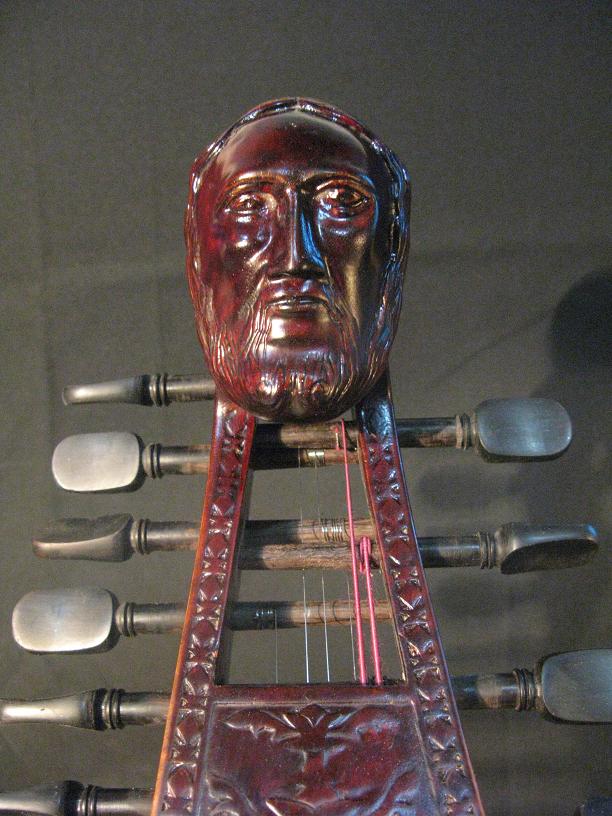
Baryton novo, 'envelhecido', do luthier chinês Song Tie Ling (à venda no eBay em 2011, por 6.900 dólares).


Detalhes do anúncio no eBay em maio de 2011:

Copy of old Baryton,viol for concert, 25 inches

6 + 10 strings, great sound #4152

Real old instrument

Quite loud and resonance sound, mellow sound

deep and sweet tone

very perfect sound

the strings are very agility, so you can easy and comfy to play it

The Fabrication Process is very complex, it will be need about 100-120 days to finished it with two master maker.

Structure design clever

It is nonsuch for the top professional player to play and collect

Great lifelike copy old finishes

Best European spruce top

Great maple back with nice flames

Beautiful carving on the top, back and neck

Hand carved with best craftmanship

Please see the detailed pictures at the followes


u SONG concert Baryton 25" . great sound, It is best for playing and collecting.

u It was made by our master maker Mr Song and two of his right-hand students . They have been to Italy to learn for further education of the technique for making violins

u Finest European Spruce Top with the even grain

u Beautiful flamed maple Back , Neck and Ribs

u The wood materials were dried in the open air over 20 years

u Excellent Condition- no cracks, no repairs, no damage.

u Ebony pegs

u Good Bridge

u Free Good Bow and rosin


Sizes:
Total lenght:51 1/2"
The body length:25"
The Scale Length: 26"
Upper bouts width:12"
Middel bouts width:8 1/2"
Lower bouts width:14 3/4"
The thickness of the ribs:4 3/4"-5"
The neck width: 5 1/8”
The width between adjacent string of the nut is about 1 11/16"(1-6 string)
The bridge width between adjacent string is about 2 1/2“(1-6 string)

Net weight: 3.410kg

Notice: We don't find the exact strings for it, so its strings we setted aren't right, please put the right strings on it by yourself. Please understand.

John Pringle (luthier) Efland NC USA


Baryton

After MAGNUS FELDLEN, Vienna 1647

SL 70.0cm

An instrument for the musician who wants to unearth the repertoire that must have existed before Haydn.

After J.J.STADLMANN, Vienna c. 1760

SL 70.0cm

This is not a copy of one instrument but an amalgam of what seemed the best features from several.

Current Price List

BARYTON
From $10,000


* * * * * * *


O baryton de MAGNUS FELDLEN, Vienna 1647, encontra-se no Royal College of Music, de Londres, sob número RCM 204 (http://www.cph.rcm.ac.uk/Catalogues/String%20Catalogue/Pages/Stringcatalogue8.htm).

Mais comentários de Rod Byatt:

"John PringleAmerican luthier makes them for $11K, one having been sold for $7K, in two styles, both with string lengths of 70cm (which makes them on par with my French 7-string basse de viole) which means to me that the fingerboard with case for sympathetic strings must be really quite wide (no wonder the Prince never played the bottom two strings). Pringle’s first style is an all-rounder suitable for the Haydn period; the second, interestingly is a design from 1645 and will appeal to those who have followed Tim Crawford’s splendid exploration into the English connectons involving Walter Rowe (1584/5-1671), English viol player who worked for most of his long life at the Brandenburg court in Berlin and Konigsberg (now Kaliningrad, Lithuania). My old mate Mersenne (1644), who tells me all I need to know about gamba in France in the first third of the C17, gets a guernsey implying that the hybrid bowed/plucked string technique was known in England before 1625."

http://rodbyatt.wordpress.com/2009/10/19/the-baryton-part-2/


As 10 principais obras de pesquisa acadêmica sobre o Baryton

De novo, aproveitando a pesquisa de Rod Byatt do blog Viola da Gamba Weblog, as 10 principais obras de pesquisa acadêmica sobre o Baryton, e de quebra um comentário importante:


A Top 11 [?] pieces of academic research, in alphabetical order:

Fruchtman, The Baryton: its History and its Music Re-examined. Acta musicologica 34/1-2, Jan-Jun 1962: 2-17

Gartrell, Carol A. Towards an Inventory of Antique Barytons. Galpin Society Journal 56/June 2003: 116-131.

Gartrell, Carol A. The Origins and Development of the Baryton, Chelys 11 (1982): 4.

Pamplin, Terence M. The Influence of the Bandora on the Origin of the Baroque Baryton. Galpin Society Journal 53 Apr 2000: 221-232.

Sadie, Stanley 18th-Century String Music. Musical Times 108/1492 Jun 1967: 541.

Sisman, Elaine R. Tradition and Transformation in the Alternating Variations of Haydn and Beethoven. Acta musicologica 62/2-3 May-Dec 1990: 152-182.

Strunk, W. Oliver Haydn’s Divertimenti for Baryton, Viola, and Bass after Manuscripts in the Library of Congress. MQ 1932/18(2): 216-251.

Webster, James The Bass Part in Haydn’s Early String Quartets. MQ 1977 63/3: 390-424.

Winkler, Gerhard J. Joseph Haydn’s “Experimental Studio” in Esterhaza. MQ 1996 80/2: 341-347.

Wollenberg, Susan Haydn’s Baryton Trios and the ‘Gradus’. Music and Letters 1973, 54(2): 170-178.


Hope to pursue these over time, but in the meantime the first page of the Pamplin journal article confirms what I’ve noted from the music downloads: the baryton is surprisingly the top voice above the viola (even above the violin in Tomasini trios) and that the manual of plucked strings is only played in 76 of over 200 trios (not used by Tomasini at all). The lower manual is tuned to the tessitura of the upper 3 of the upper manual bass viol strings and not the lower three – hence the curiosity of a bass-tessitura instrument playing above the violin/viola!

Posted by rodbyatt
http://rodbyatt.wordpress.com/2009/10/21/the-baryton-part-3/


* * * * * * *

E para complementar, a "resenha" de Rod do livro de Carol Gartrell, publicada em seu blog após a lista acima:

Carol A Gartrell, A History of the Baryton and its Music


The first hundred or so pages are devoted to a history of the instrument, followed by thirty or so pages of black-and-white photos and text describing extant antique barytons, ending up with an inventory of sheet music, being a single example of compositions for baryton by composers other than Haydn.

The text provides answers to any question one is ever likely to ask about the history of the music and music composed for it. The inventory of instruments is of course superlative and the presence of ‘sheet music’ examples is a godsend. The book forms the cornerstone of any collection of material about the baryton, linking the fragments of information available online and from CD recordings.

Posted by rodbyatt (November 22, 2009)
http://rodbyatt.wordpress.com/2009/11/22/the-baryton-carol-a-gartrell-a-history-of-the-baryton-and-its-music/